
Death at a Festival
Updated: Jan 26

This is satire
It was supposed to be a perfect weekend.
The festival was “sold out” (capacity adjusted).
The lineup was “curated” (agents answered emails).
The crowd was “community” (everyone wore the same sunglasses).
Then someone died.
Not metaphorically. Not spiritually. Actually died. On festival grounds. Somewhere between the VIP compost toilets and a branded hydration station.
At first, no one knew what to do—which is impressive, considering everyone there claims to be a professional.
The promoter checked the schedule.
The brand rep checked the optics.
The DJs checked whether this would affect their set time.
Someone suggested a moment of silence. Someone else asked if it could be filmed vertically.
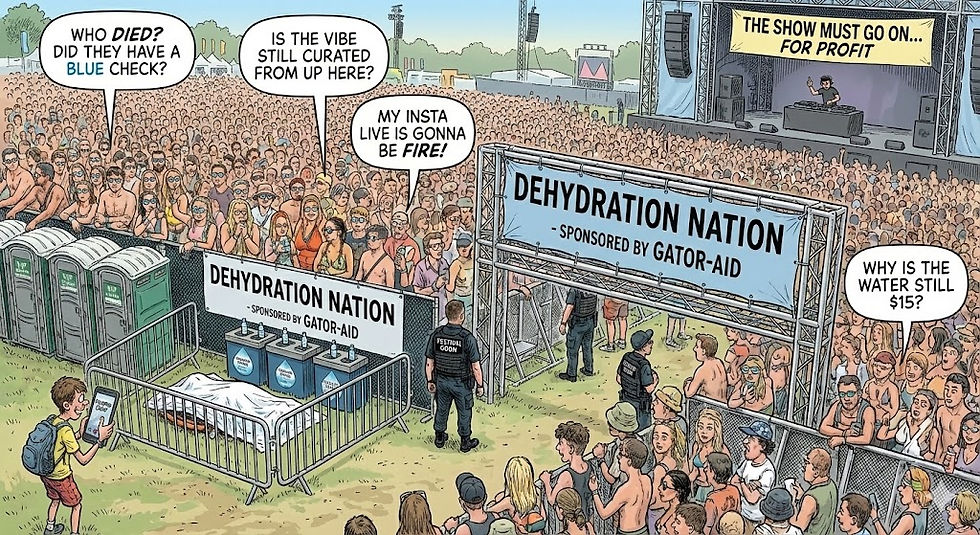
Holding Space (But Not Too Much)
Within minutes, the language kicked in.
It wasn’t a death. It was an incident.
Not a tragedy—*an unforeseen situation*.
Definitely not something that should “kill the vibe.”
A statement was drafted before the body was identified.
“We are holding space for the individual and their loved ones,” it read, written by someone who had never met either.
The wellness tent offered guided breathing sessions. The merch booth stayed open. The bass didn’t stop—because nothing says respect like a subwoofer rattling through a field while someone is zipped into a black bag.
Grief, after all, is bad for bar sales.

The Archetypes Reveal Themselves
The Headliner paced backstage, visibly shaken.
Not by the death—by the possibility their closing slot might move earlier. They briefly considered dedicating their set to the deceased, then remembered they didn’t know their name.
The Influencer cried sincerely for a full thirty seconds, then asked if it was “okay to post something tasteful.” They went with black-and-white. Engagement was strong.
The Brand Rep suggested a candlelight vigil, presented by a tequila company. Someone asked if the candles could match the sponsor palette.
The “Underground” DJ shook their head and muttered, “This is why I hate festivals.”
They still asked for a wristband upgrade.
Community, But Contractually
No one asked how the person died.
Only whether acknowledging it would require refunds.
Security tried to reroute foot traffic. The social media manager pinned a comment. A group chat titled “Crisis (Do Not Leak)” ballooned to forty people, none of whom were equipped to deal with an actual human death.
Someone finally asked the question everyone was avoiding:
“Are we… still running tomorrow?”
The answer came quickly.
“Yes.”
Of course yes.
Because the festival wasn’t built to stop. It was built to continue—no matter what, no matter who.
Who Gets to Matter
Later, rumors spread.
If the deceased had been famous, the weekend would’ve ended.
If they had a blue check, the lineup would’ve paused.
If they had management, there would’ve been a tribute edit.
But they didn’t.
They were just a person who showed up for music and didn’t make it home.
Which, in modern festival math, means they were unfortunate—but not important.
Encore
By Sunday night, everything was back on track.
Stories expired. Sets were uploaded. The statement was buried. The festival thanked everyone for “coming together.”
And somewhere between the recap video and the early-bird ticket drop, the death became what it was always going to be:
A footnote.
A liability.
An inconvenience.
Because at the end of the day, the only unforgivable sin in rave culture isn’t exploitation, or dishonesty, or even death.
It’s disrupting the schedule.
End


Comments