
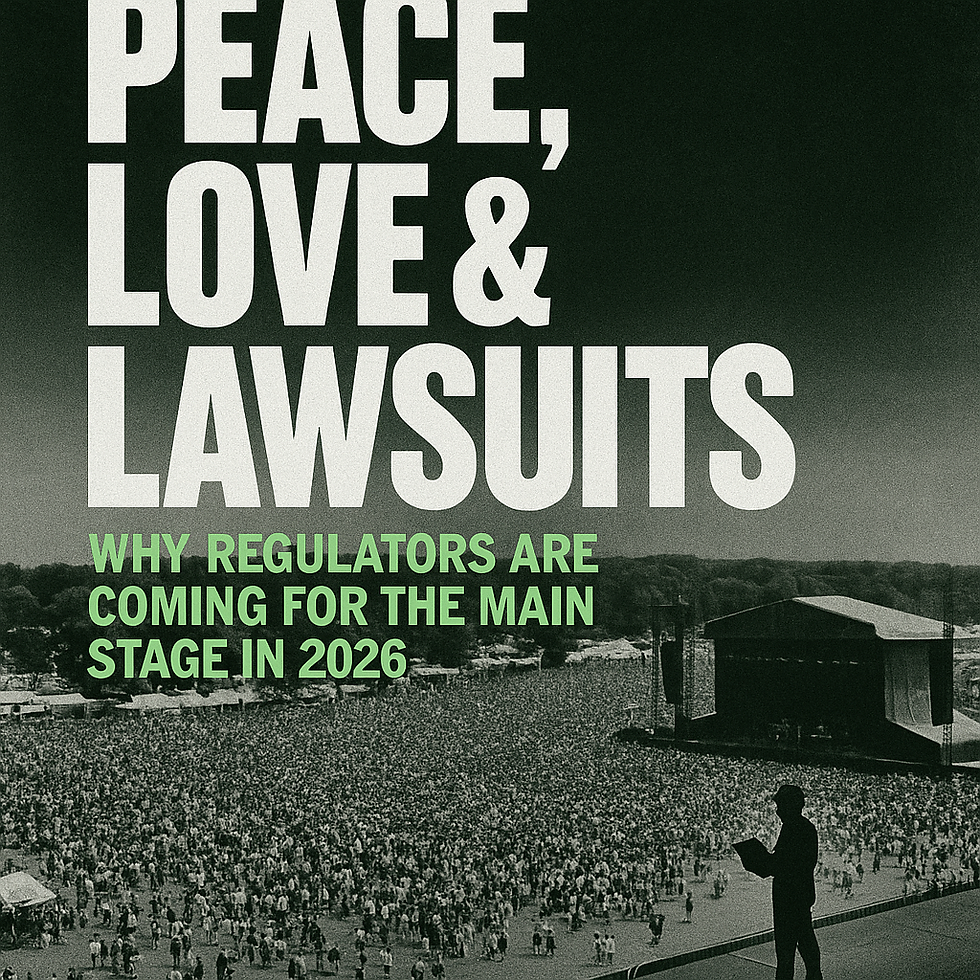
Peace, Love & Lawsuits: Why Regulators Are Coming for the Main Stage
- SAF
- Sep 29, 2025
- 3 min read

Music festivals like to frame themselves as modern-day utopias: weekend democracies where basslines and biodegradable glitter dissolve all real-world problems. But the numbers — and the headlines — tell a less sparkly story.
From Altamont to Astroworld, the history of large-scale festivals reads like an uneasy mix of hubris, crowd-math failures, weather roulette, and good old-fashioned negligence. Now, with new insurance models, activist watchdogs, and the climate literally breathing down everyone’s neck, 2026 is shaping up to be the year the industry finally gets dragged under a microscope it’s spent decades dodging.
Act I: The Myth of Peace & Love Was Mostly Logistics on Fire
The modern festival fantasy started in the late ’60s — mud-slicked fields, “free” spirits, no traffic plans.
Woodstock ‘69 became the founding myth: 400,000 people, not enough toilets, few fatalities by sheer luck.
That luck ran out at Altamont (1969) when the Hells Angels — inexplicably hired as security — killed 18-year-old Meredith Hunter in front of the stage.
By Isle of Wight 1970 and Summer Jam ‘73, local governments were already panicking about infrastructure collapse.
The takeaway: festivals were never that safe; they were just romanticized because everyone was barefoot and on acid.
Act II: The ‘80s & ‘90s — The Corporates Arrive, So Do Riots
By the mid-’80s, the field-party aesthetic collided with big-ticket capitalism.
US Festival ‘83: funded by Apple’s Steve Wozniak, infamous for dehydration deaths in the California sun.
Woodstock ‘94 turned into a mud-wrestling pit that caused $135M in damages.
Woodstock ‘99 was the full dystopia: $4 water, 100-degree heat, widespread sexual assaults, fires, riots — basically Lord of the Flies with Limp Bizkit.
Across the Atlantic, Roskilde 2000 saw nine Pearl Jam fans crushed to death in front of the stage — a tragedy that finally forced European crowd-flow reforms.
The industry learned the wrong lesson: brand partnerships exploded, but safety budgets barely twitched.

Act III: The EDM Boom & the “Everything’s Fine” Era
The 2000s-2010s EDM wave brought lasers, global tourism, and a shiny new PR language about “wellness” and “community.”
Love Parade 2010 (Germany): 21 dead, 500 injured in a tunnel crush.
Pukkelpop 2011 (Belgium): a freak storm flattened stages, killing five.
Fyre Festival 2017: the greatest logistical catfish of all time (no deaths, but the trauma of those FEMA cheese sandwiches will live forever).
Astroworld 2021: ten dead in a crowd surge, 300+ injured. The lawsuits have since redefined liability for promoters in North America.
Meanwhile, Coachella, Ultra, and others quietly averaged several heat- and drug-related deaths each season.
Act IV: The Silent Crises Nobody Likes to Post About
Environment: Glastonbury has polluted nearby rivers multiple times; Burning Man’s carbon footprint became a climate-era punching bag.
Labour: Behind-the-scenes crews often work 16-hour shifts for peanuts — several lawsuits in the US and EU are now forcing wage transparency.
Accessibility: ADA lawsuits in the US (Coachella settled in 2014) revealed chronic negligence toward disabled attendees.
These issues have existed as long as the festivals themselves — they just never made it to the after-movie.
Act V: 2026 — The Reckoning
The future of festival culture isn’t all doom, but it’s definitely paperwork-heavy:
Insurance companies now demand real-time crowd-density monitoring after Astroworld.
Climate risk means extreme-weather contingency plans will soon be legally mandated in Canada, the EU, and several US states.
Activists and watchdog orgs (covering labour, environmental impact, accessibility) have finally built enough traction to drag negligent promoters to court or the front page.
City councils in BC, California, and parts of Europe are considering stricter licensing caps — not on headliner decibels, but on evacuation routes.
In short: the days of winging it with zip-tied fences and vibes are numbered.
SAF Says…
This isn’t about hating on the rave in the woods. It’s about admitting that for six decades, the business model has treated safety as an optional expense and crowds as expendable.
The scrutiny coming in 2026 isn’t a buzzkill; it’s overdue damage control.
So the next time a promoter waxes poetic about “transformative festival experiences”, remember: the transformation we actually need is boring — better barricades, honest water pricing, unionized crews, climate-proof stages.
The underground will adapt. The mega-fests? They’re about to find out that the regulators don’t care about your holographic stage dragon.
Come to Safeasfx Halloween Rave - We promise we won’t lie to you about literally everything
Friday, October 31 🎃 - GET TICKETS HERE


Comments